
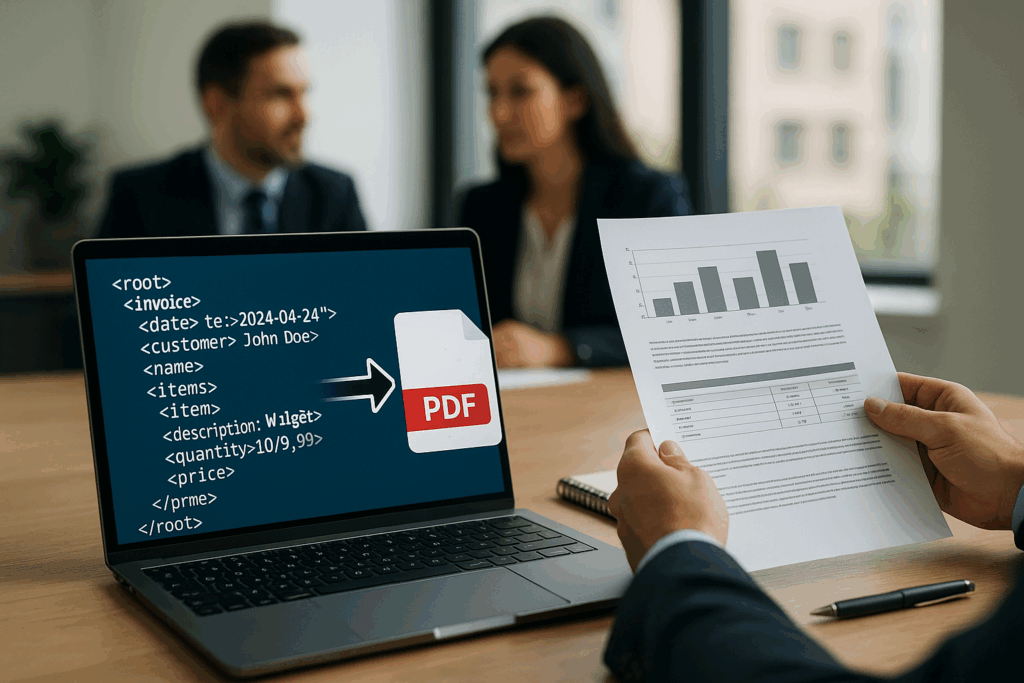
Modern businesses generate vast amounts of structured data daily, yet face significant challenges when sharing this information professionally. XML files, while excellent for data storage and system integration, lack the visual appeal and universal accessibility required for business presentations and stakeholder communications. Organizations need reliable xml to pdf conversion solutions to transform their structured XML data into presentation-ready formats that maintain data integrity while ensuring consistent appearance across different platforms.
The growing demand for efficient document workflows has made XML to PDF conversion an essential capability for businesses across all industries. This transformation bridges the gap between raw data management and professional document presentation, enabling organizations to maintain their structured data advantages while meeting the practical needs of modern business communication.
This comprehensive guide explores the strategic importance of XML to PDF conversion, examining key business applications, technical considerations, and best practices for implementing these solutions effectively in enterprise environments.
Understanding XML and PDF in Business Context
XML (Extensible Markup Language) serves as a cornerstone of modern data management, providing a standardized method for structuring and describing information. This W3C open standard for describing data using embedded tags has become the foundation for business-to-business transactions, electronic-data interchanges and Web services. Industry analysis from leading research organizations consistently identifies XML as essential infrastructure for enterprise data management.
The format excels in scenarios requiring data interchange between different systems, applications, and organizations. XML’s hierarchical structure allows complex data relationships to be represented clearly, making it invaluable for enterprise resource planning, customer relationship management, and supply chain coordination. However, XML’s technical nature presents challenges when information needs to be shared with non-technical stakeholders or presented in formal business contexts.
PDF (Portable Document Format) addresses these presentation challenges by providing a universal format that maintains consistent appearance across all devices and platforms. Unlike XML’s focus on data structure, PDF prioritizes visual presentation and document integrity, ensuring that reports, presentations, and formal documents appear identical regardless of the viewing environment.
Key differences between XML and PDF formats:
- Purpose: XML focuses on data structure and machine readability, while PDF emphasizes visual presentation and human readability
- Accessibility: XML requires specialized software for proper viewing, whereas PDF can be opened by virtually any device or application
- Editability: XML allows easy data manipulation and extraction, while PDF maintains document integrity through format preservation
- Presentation: XML provides no visual formatting, while PDF ensures consistent appearance across all viewing platforms
Key Business Applications for XML to PDF Conversion
The conversion from XML to PDF serves critical business functions across multiple industries and organizational contexts. Financial institutions regularly transform XML-based transaction reports into PDF statements for client distribution, ensuring regulatory compliance while maintaining professional presentation standards. Healthcare organizations convert patient data stored in XML format into PDF reports for easy sharing between medical professionals and insurance providers.
Manufacturing companies utilize XML to PDF conversion for creating professional documentation from their enterprise resource planning systems. Production schedules, inventory reports, and quality assurance documentation often originate as structured XML data but require PDF format for distribution to suppliers, customers, and regulatory bodies. This transformation ensures that critical business information maintains its accuracy while becoming accessible to stakeholders who may not have specialized XML viewing capabilities. Industry research confirms that structured data formats like XML continue to serve as essential infrastructure for enterprise data management.
Industry-Specific Use Cases
Government agencies represent another significant application area, where XML databases containing citizen information, regulatory filings, and compliance reports must be converted to PDF format for public disclosure and official documentation. The conversion process ensures that sensitive structured data can be shared safely while maintaining the professional appearance required for official communications.
Top business applications for XML to PDF conversion:
- Financial Reporting: Transform transaction data and compliance reports into professional PDF documents
- Healthcare Documentation: Convert patient records and medical data into shareable PDF formats
- Manufacturing Documentation: Create professional reports from ERP and supply chain XML data
- Legal Documentation: Transform case data and regulatory filings into court-ready PDF formats
- Educational Records: Convert student information systems data into official PDF transcripts and reports
The retail industry also benefits significantly from XML to PDF conversion, particularly for inventory management and supplier communications. Product catalogs, purchase orders, and inventory reports frequently begin as XML data but require PDF conversion for professional presentation to vendors and business partners.
Choosing the Right XML to PDF Solution
Selecting an appropriate XML to PDF conversion solution requires careful consideration of multiple factors that impact both immediate functionality and long-term business value. Organizations must evaluate their specific requirements, including data volume, conversion frequency, security needs, and integration capabilities with existing business systems.
Security considerations play a crucial role in solution selection, particularly for organizations handling sensitive data. Recent studies on document management security emphasize that proper security protocols must be established for data transformation processes, with comprehensive security frameworks becoming increasingly important for enterprise document workflows.
Modern businesses require solutions that can handle both individual file conversions and batch processing capabilities. High-volume organizations need systems capable of processing hundreds or thousands of XML files simultaneously while maintaining conversion quality and system performance. Cloud-based solutions offer particular advantages for scalability and accessibility, allowing teams to perform conversions from any location while maintaining centralized security controls.
Integration capabilities with existing business systems represent another critical selection factor. The most effective XML to PDF solutions seamlessly connect with enterprise resource planning systems, customer relationship management platforms, and document management systems. This integration eliminates manual file transfer processes and enables automated workflow creation that improves overall business efficiency.
Essential criteria for selecting XML to PDF conversion tools:
- Security Features: Robust data protection, encryption capabilities, and compliance with industry standards
- Scalability: Ability to handle varying conversion volumes without performance degradation
- Integration Options: Compatibility with existing business systems and workflow automation tools
- Conversion Quality: Accurate data transformation with professional formatting and layout options
- Support and Reliability: Comprehensive technical support and proven system uptime performance
The investment in proper XML to PDF conversion capabilities pays dividends through improved document workflows, enhanced professional presentation, and increased efficiency in business communications. Organizations that implement these solutions effectively position themselves to better serve customers, partners, and stakeholders while maintaining the structured data advantages that XML provides for their core business operations.